5 lines are enough. We reply by email or WhatsApp and set up a conversation.
Games for education
Educational games, custom-built around what your students need to learn.
For schools, universities, courses and training programs. We design the game around the subject, so students practice what they study and want to come back for the next level.
Class time competes with a phone designed to hold attention
For 6 years, I taught business administration, marketing, entrepreneurship and finance, from technical school to MBA programs. The same scene played out in every class: the lesson on the board and the student's attention on a phone under the desk. PISA 2022, the OECD's international assessment, measured that same scene. Across OECD countries, on average, 30% of 15-year-olds said they get distracted by digital devices in most math lessons.
It is an uneven contest, for a simple reason. What holds attention on a phone is game mechanics: a challenge at the right level, progress you can see, a reward right after the effort. Whole teams of engineers work to make that happen. The lesson, on the other side, still depends on someone listening for 40 minutes straight.
The world changed quickly with new technology, and our education systems have not caught up yet. Students are the ones who lose.
- 30%of 15-year-olds say they get distracted by digital devices in most math lessonsPISA 2022, OECD average
- 7×more time playing when the subject is inside the mechanicHabgood and Ainsworth, 2011
- 40+ yearsof research on games in educationsince Malone, 1981
Videos, handouts and point-based quizzes solve only part of it
A video lesson takes the content anywhere, and the student is still only watching. A handout organizes the subject, and it cannot show what happens when someone applies it the wrong way. A quiz with points adds some rhythm, and it asks what the student remembers rather than what they would do.
All of them are missing the same piece: practice. Nobody learns to run a business by memorizing the definition of cash flow. People learn when the cash runs out and they have to decide what to do.
Gamification opened the door. The next step is the whole game
Using the best of games to teach is an idea that has been studied for more than 40 years. In 1981, Thomas Malone looked at what makes a game fun so he could bring it into the classroom. In 2003, researcher James Paul Gee showed that good video games quietly apply learning principles education has known for a long time. In 2011, game designer Jane McGonigal argued that games can improve life beyond the screen.
That same year, researchers named a shorter path: gamification, which takes game elements such as points, badges and leaderboards outside of games. It spread through schools and companies around the world, and today it sits alongside the older path, the complete game built to teach.
Most of the time, the gamification that reaches students is a layer: points, badges and a leaderboard on top of the same activity as always. It is a good first step, and research shows it helps. A badge for a finished task, though, does not turn the task into a game, and the activity stays exactly as engaging as it was before the badge.
What we offer is the next level. The game comes first, and the learning lives inside it. Instead of placing pieces of a game into a lesson, we build a complete game, with story, challenge and consequence, where moving forward requires using the subject. Students play because they want to play, and they learn because that is the only way to win.
In a game, students decide, make mistakes at no cost and try again until it sticks
A well-designed game puts students in the seat of the person who has to solve the problem. Each level trains a real decision, the consequence shows up right away, and a mistake becomes learning instead of a bad grade. The same mechanics that hold attention on a phone start working for the subject.
An example we have already designed: a school for entrepreneurs inside a business game
Games where you run a farm, build a grocery store or manage a bar bring together millions of players around the world. People have fun building a business and, along the way, learn something about it.
Now imagine that same game designed to teach. The student starts with a market stall and grows into a shop of their own. Along the way, every decision is a real one: how much to charge, how much stock to buy, when to hire, how to respond to a competitor who opened next door or to a slow month. Behind each level are the concepts an entrepreneur needs to master:
- Economics: supply, demand and why prices go up and down.
- Finance: the difference between profit and cash in the till, cost, margin and working capital.
- Management: inventory, staff, processes and priorities.
- Marketing: who the customer is, how they find the shop and why they come back.
The result is a complete entrepreneurship course where students learn by doing: they decide like an entrepreneur, make mistakes without losing real money, and carry that decision-making experience into real life. The idea has a track record. Business simulations have been used in business schools for decades and are among the most studied uses of games in education.
It is one of the ideas that grew out of my path between the classroom and entrepreneurship. Today our team is focused on our RPG. An educational project of this size calls for its own team, and it begins when we find the right institution or partner to build it with.
The same approach works for any subject
History, science, languages, math, financial education, technical training. Any content students need to apply, and not only remember, can become a game.
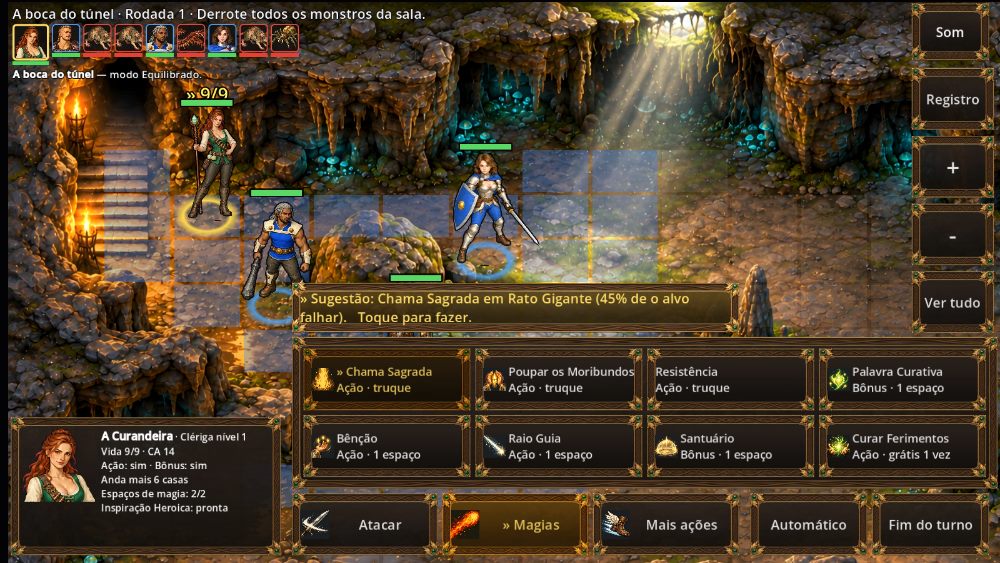
Our own RPG already works as a lesson in disguise. Beneath the fantasy, it deals with power, belief and human behavior, themes real history knows well. Players have fun and, at the same time, think about how people and societies work.
Who we design educational games for
- Primary and secondary schools
- Universities and colleges
- Short courses, technical and vocational programs
- Education companies and learning platforms
- Training programs run by institutions, foundations and social projects
How it starts
You tell us what you need to teach.
Who the students are, what should change after they play, and where the game will run.
We talk and design it together.
A few questions, a proposed path, and the game summed up on a single page, before the first line of code.
You play before you decide.
Before the full project, you play a vertical slice: a small piece of the game that already looks and plays like the final version. We work in short cycles, with a playable version at the end of each stage. A prototype that used to take months now takes weeks, and that is why the cost is fairer too.
Who designs the games

Paulo Ribeiro, founder of Nextborn Games. He taught for 6 years, from technical school to MBA programs, holds a degree in Business Administration and a postgraduate degree in Education, and spent 7 years in the games industry, across community, esports and content creators. He has been a tabletop RPG game master since he was 12.
Frequently asked questions about educational games
Will the game run on the school's computers and phones?
Most of our games run right in the browser, on computers and phones, with nothing to install. We settle this in the first conversation, based on what the school already has.
How much does a custom educational game cost?
It depends on the size: how many levels, how many topics and for how many students. Since each project is designed for your case, the price comes with the proposal. Short cycles and a lean team keep the cost fairer than traditional development.
How long does it take?
That also depends on the scope. What changes with the way we work is that the first playable version is ready in weeks, and you follow every stage by playing it.
Can we track each student's learning?
Yes. The game records each student's decisions and progress, and the teacher sees where the class moved ahead and where it got stuck. How learning is measured is designed together with the institution, for each project.
Does the teacher need to understand games?
No. The game is designed to be used in class or at home with minimal explanation, and we provide materials for the teacher to lead the activity.
What is the difference between gamification and an educational game?
Gamification adds points, badges and leaderboards to an activity that already exists. An educational game places the subject inside a complete game, with story, challenge and consequence, where students only move forward by using what they have learned.
The science behind it
I taught for 6 years, from technical school to MBA programs, and earned a postgraduate degree in Education. That path left me with a habit: asking for the source before believing in a new method, including my own. This section is for people who decide based on evidence. It covers what research supports about games in education, what it does not yet guarantee, and where Nextborn stands. Every claim has a full reference at the end of the page.
Attention in class has a number
PISA 2022, the OECD's assessment of 15-year-old students, measured what every teacher sees from the front of the room. Across OECD countries, on average, 30% of students said they get distracted by digital devices in most math lessons, and 25% said they get distracted by other students' devices. Students who report that second kind of distraction in at least some lessons score 15 points lower in math, after accounting for socioeconomic status (OECD, 2023). UNESCO's report on technology in education adds that the mere presence of a phone is distracting and harms learning, in studies from 14 countries (UNESCO, 2023).
A popular talking point deserves to be set aside here: the idea that students can only pay attention for 10 or 15 minutes. Wilson and Korn (2007) reviewed the studies behind that idea and found little support for it. Bunce, Flens and Neiles (2010) measured attention in class and saw something else: it drifts in short lapses, a minute or less, in cycles that get shorter as the lesson goes on, and each interactive activity reduces those lapses. What decides attention is what happens inside the lesson, far more than how long it lasts.
What holds attention has a name
Phones hold attention for reasons psychology has known for decades. In 1981, Thomas Malone studied computer games to find out what made them fun and identified 3 sources of motivation: challenge, fantasy and curiosity. Challenge works when the outcome is uncertain and the difficulty adjusts. Csikszentmihalyi (1990) described the state of total absorption, flow, which appears when the challenge matches the person's skill. Ryan, Rigby and Przybylski (2006) showed that the appeal of games comes from 3 basic needs: feeling competent, deciding with autonomy and belonging to a group.
This holds up in educational games. Hamari and colleagues (2016) followed 173 students in 2 educational games and found that challenge at the right level was the factor that best predicted perceived learning, both directly and through engagement. The design lesson: the challenge has to grow along with the student's skill.
4 decades of research and 3 different names
Clark Abt coined the term serious games in 1970 for games made with an educational purpose. Malone published his theory in 1981. James Paul Gee argued in 2003 that good games apply learning principles recognized by cognitive science. In 2005, Shaffer, Squire, Halverson and Gee argued that games matter because they place the player inside simulated worlds, and warned that most educational games up to then had been made without any theory of learning behind them. In 2011, Deterding and colleagues gave gamification its academic definition. From 2011 to 2020, a series of meta-analyses measured what all of this produces in the classroom.
The literature separates what the market tends to mix together. Gamification is the use of game elements outside a game: points, badges and leaderboards on top of an activity that already exists (Deterding et al., 2011). Landers (2014) explains the mechanism: the badge acts on a behavior, such as doing more exercises or coming back more often, and it is that behavior that can raise the grade. The content stays outside the badge. A serious game is a complete game designed with a purpose beyond entertainment (Abt, 1970). Here the subject lives inside the mechanics: moving forward requires using the content. Research on the two is separate, and this section keeps them separate.
What the layer delivers and where it stops
The layer of points and badges works, and the numbers say how much. Sailer and Homner (2020) pooled the studies and found a consistent effect of gamification on learning (g = 0.49, across 19 studies with 1,686 participants), on motivation (g = 0.36) and on behavior (g = 0.25). In classroom terms: the average student in the gamified class ends up ahead of about two thirds of the students in the regular class. The first review of the field had already warned that the effect depends heavily on context and on who is using it (Hamari, Koivisto and Sarsa, 2014).
The psychology of motivation explains the limit. Deci, Koestner and Ryan (1999) brought together 128 experiments and showed that expected rewards reduce interest in the activity itself, while positive feedback increases it. A badge for a finished task belongs to the first group. This has been measured in the classroom: Hanus and Fox (2015) followed a 16-week university course with badges, coins and a leaderboard, compared with the same course without those elements, and the gamified group ended the semester with less motivation and less satisfaction. Sailer and colleagues (2017) showed that each element has its own effect: badges and leaderboards feed the sense of competence; story, characters and teammates feed the sense of belonging. And there is the novelty effect, measured in Brazil: Rodrigues and colleagues (2022) followed 756 Brazilian students for 14 weeks and saw the effect of gamification drop after the fourth week and only rise again between the sixth and the tenth.
The badge changes the behavior around the task. The task stays the same.
What changes when the subject becomes the mechanics
As early as 1981, Malone separated extrinsic fantasy, which depends little on the skill used in the game, from intrinsic fantasy, which is tied to using that skill. 30 years later, Habgood and Ainsworth (2011) turned the idea into an experiment. They built 2 versions of the same math game for children aged 7 to 11. In one, division was the game's mechanic; in the other, the same math appeared on screens separate from the action. Children learned more in the version where the subject was inside the mechanic and, when they could choose what to play, spent 7 times as long in it. Students play because they want to play, and they learn along the way.
Meta-analyses of complete games point the same way. Wouters and colleagues (2013), with 77 comparisons and 5,547 participants, found more learning (d = 0.29) and more retention (d = 0.36) with serious games than with conventional instruction, with larger gains when the game is part of the lesson, used over more than one session and played in groups. Clark, Tanner-Smith and Killingsworth (2016), with 57 studies, showed that games outperform non-game conditions (g = 0.33) and that a well-designed version outperforms the basic version of the same game by an effect of the same size. In their words, the result highlights the central role of design, beyond the medium itself. Sailer and Homner (2020) found that including story, characters and a world was one of the 2 factors that most helped change student behavior. The other was combining competition with collaboration.
The oldest and most studied application of this is the business simulation, used in business schools for more than 40 years (Faria et al., 2009). Sitzmann (2011), in a meta-analysis of 65 studies with 6,476 participants, measured gains of 11% in declarative knowledge, 14% in procedural knowledge and 9% in retention for those who learned with simulations, and found that simulations work better when they complement instruction than when they replace it. In Brazil, the Management Laboratory at FEA-USP (the School of Economics, Business and Accounting of the University of São Paulo) has combined business simulation with research for years (Ribeiro et al., 2015). The same field acknowledges its own gap: Anderson and Lawton (2009) showed that students and instructors perceive a great deal of learning in simulations, but that for 25 years few people rigorously measured what students actually learned.
This is what Nextborn builds on. The game comes first, with story, challenge and consequence, and the subject is what makes the student move forward.
What we do with what the science says
3 method decisions come straight from the studies.
The game is part of the lesson, with materials for the teacher to lead it, because that is where it works best (Wouters et al., 2013; Sitzmann, 2011). The challenge of each level is tuned in testing with real students before the project is finalized, because a well-calibrated challenge is what sustains learning (Hamari et al., 2016). Every student decision is recorded, and the way learning is measured is designed together with the institution, because the field has been asking for this for 25 years (Anderson and Lawton, 2009).
In Brazil, the path is open. Brazil's national curriculum, the Base Nacional Comum Curricular (BNCC), calls in general competency 5 for students to "understand, use and create digital information and communication technologies in a critical, meaningful, reflective and ethical way" (our translation) in order to "solve problems and exercise protagonism and authorship" (our translation), and in general competency 2 to "develop and test hypotheses, formulate and solve problems and create solutions" (our translation) (Brasil, 2018). A game where students decide, make mistakes and try again is one of the most direct ways to practice both. Law No. 14,852 of May 3, 2024, known as Brazil's Legal Framework for Games, authorizes the use of electronic games "in school settings, for teaching purposes, in accordance with the Base Nacional Comum Curricular (BNCC)" (our translation) and provides for incentives for research and development of games aimed at education (art. 10, item II; art. 13, § 1, item IV).
The science says games teach, with a consistent effect, when they are well designed and part of the lesson. That is exactly the work Nextborn sets out to do with your institution. If you want to see this with your students, tell us what you need to teach in the form below. The conversation starts there.
References
- Abt, C. C. (1970). Serious games. Viking.
- Anderson, P. H., & Lawton, L. (2009). Business simulations and cognitive learning: Developments, desires, and future directions. Simulation & Gaming, 40(2), 193-216. https://doi.org/10.1177/1046878108321624
- Brasil. Ministério da Educação. (2018). Base Nacional Comum Curricular [National Common Curricular Base]. MEC. http://basenacionalcomum.mec.gov.br/abase/
- Brasil. (2024). Lei nº 14.852, de 3 de maio de 2024. Cria o marco legal para a indústria de jogos eletrônicos [Law No. 14,852 of May 3, 2024. Creates the legal framework for the electronic games industry]. Diário Oficial da União, May 6, 2024.
- Bunce, D. M., Flens, E. A., & Neiles, K. Y. (2010). How long can students pay attention in class? A study of student attention decline using clickers. Journal of Chemical Education, 87(12), 1438-1443. https://doi.org/10.1021/ed100409p
- Clark, D. B., Tanner-Smith, E. E., & Killingsworth, S. S. (2016). Digital games, design, and learning: A systematic review and meta-analysis. Review of Educational Research, 86(1), 79-122. https://doi.org/10.3102/0034654315582065
- Csikszentmihalyi, M. (1990). Flow: The psychology of optimal experience. Harper & Row.
- Deci, E. L., Koestner, R., & Ryan, R. M. (1999). A meta-analytic review of experiments examining the effects of extrinsic rewards on intrinsic motivation. Psychological Bulletin, 125(6), 627-668. https://doi.org/10.1037/0033-2909.125.6.627
- Deterding, S., Dixon, D., Khaled, R., & Nacke, L. (2011). From game design elements to gamefulness: Defining "gamification". In Proceedings of the 15th International Academic MindTrek Conference (pp. 9-15). ACM. https://doi.org/10.1145/2181037.2181040
- Faria, A. J., Hutchinson, D., Wellington, W. J., & Gold, S. (2009). Developments in business gaming: A review of the past 40 years. Simulation & Gaming, 40(4), 464-487. https://doi.org/10.1177/1046878108327585
- Gee, J. P. (2003). What video games have to teach us about learning and literacy. Palgrave Macmillan.
- Habgood, M. P. J., & Ainsworth, S. E. (2011). Motivating children to learn effectively: Exploring the value of intrinsic integration in educational games. Journal of the Learning Sciences, 20(2), 169-206. https://doi.org/10.1080/10508406.2010.508029
- Hamari, J., Koivisto, J., & Sarsa, H. (2014). Does gamification work? A literature review of empirical studies on gamification. In Proceedings of the 47th Hawaii International Conference on System Sciences (pp. 3025-3034). IEEE. https://doi.org/10.1109/HICSS.2014.377
- Hamari, J., Shernoff, D. J., Rowe, E., Coller, B., Asbell-Clarke, J., & Edwards, T. (2016). Challenging games help students learn: An empirical study on engagement, flow and immersion in game-based learning. Computers in Human Behavior, 54, 170-179. https://doi.org/10.1016/j.chb.2015.07.045
- Hanus, M. D., & Fox, J. (2015). Assessing the effects of gamification in the classroom: A longitudinal study on intrinsic motivation, social comparison, satisfaction, effort, and academic performance. Computers & Education, 80, 152-161. https://doi.org/10.1016/j.compedu.2014.08.019
- Landers, R. N. (2014). Developing a theory of gamified learning: Linking serious games and gamification of learning. Simulation & Gaming, 45(6), 752-768. https://doi.org/10.1177/1046878114563660
- Malone, T. W. (1981). Toward a theory of intrinsically motivating instruction. Cognitive Science, 5(4), 333-369. https://doi.org/10.1207/s15516709cog0504_2
- OECD. (2023). PISA 2022 results (Volume II): Learning during and from disruption. OECD Publishing. https://doi.org/10.1787/a97db61c-en
- Ribeiro, R. P., Sauaia, A. C. A., Mello, A. M., & Torres, A. S. (2015). Praticando gestão de operações em um laboratório de gestão [Practicing operations management in a management laboratory]. RAM, Revista de Administração Mackenzie, 16(4), 43-76. https://doi.org/10.1590/1678-69712015/administracao.v16n4p43-76
- Rodrigues, L., Pereira, F. D., Toda, A. M., Palomino, P. T., Pessoa, M., Carvalho, L. S. G., Fernandes, D., Oliveira, E. H. T., Cristea, A. I., & Isotani, S. (2022). Gamification suffers from the novelty effect but benefits from the familiarization effect: Findings from a longitudinal study. International Journal of Educational Technology in Higher Education, 19, Article 13. https://doi.org/10.1186/s41239-021-00314-6
- Ryan, R. M., Rigby, C. S., & Przybylski, A. (2006). The motivational pull of video games: A self-determination theory approach. Motivation and Emotion, 30(4), 344-360. https://doi.org/10.1007/s11031-006-9051-8
- Sailer, M., Hense, J. U., Mayr, S. K., & Mandl, H. (2017). How gamification motivates: An experimental study of the effects of specific game design elements on psychological need satisfaction. Computers in Human Behavior, 69, 371-380. https://doi.org/10.1016/j.chb.2016.12.033
- Sailer, M., & Homner, L. (2020). The gamification of learning: A meta-analysis. Educational Psychology Review, 32(1), 77-112. https://doi.org/10.1007/s10648-019-09498-w
- Shaffer, D. W., Squire, K. R., Halverson, R., & Gee, J. P. (2005). Video games and the future of learning. Phi Delta Kappan, 87(2), 105-111. https://doi.org/10.1177/003172170508700205
- Sitzmann, T. (2011). A meta-analytic examination of the instructional effectiveness of computer-based simulation games. Personnel Psychology, 64(2), 489-528. https://doi.org/10.1111/j.1744-6570.2011.01190.x
- UNESCO. (2023). Global education monitoring report 2023: Technology in education: A tool on whose terms? UNESCO. https://unesdoc.unesco.org/ark:/48223/pf0000385723
- Wilson, K., & Korn, J. H. (2007). Attention during lectures: Beyond ten minutes. Teaching of Psychology, 34(2), 85-89. https://doi.org/10.1080/00986280701291291
- Wouters, P., van Nimwegen, C., van Oostendorp, H., & van der Spek, E. D. (2013). A meta-analysis of the cognitive and motivational effects of serious games. Journal of Educational Psychology, 105(2), 249-265. https://doi.org/10.1037/a0031311